

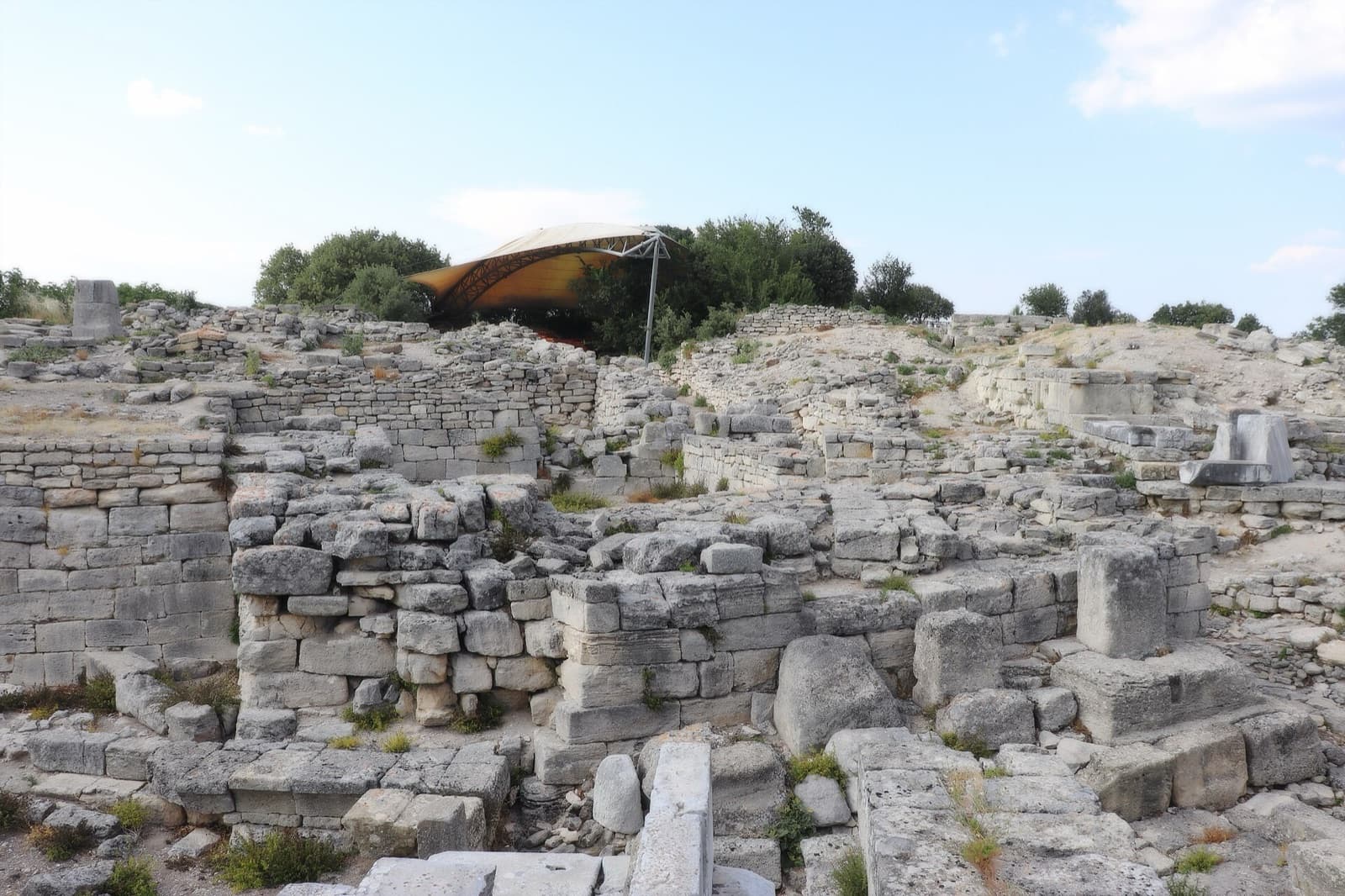
Photo: Ebru Sargın L., CC BY-SA 4.0, Wikimedia Commons
Hotel Marmara · September 29, 2026
Troy Ancient City and Troy Museum: How to Visit from Çanakkale
The ancient city of Troy and the Troy Museum share an area but are two separate stops. How to get there from central Çanakkale by car or dolmuş, which to see first, how long to allow and what the nine layers mean — a practical half-day guide.
Seeing Troy in One Visit: the Museum and the Ancient City
Troy has been on the UNESCO World Heritage List since 1998, and Homer's Iliad made its name known worldwide; it lies on the mound of Hisarlık, beside the village of Tevfikiye, south of Çanakkale. One detail first-time visitors often miss: the ancient city of Troy (the archaeological site) and the Troy Museum are in the same area but are two separate stops. Planned as a single visit, they make for a richer and more relaxed day. If you would like to combine Troy with Gallipoli, see our Troy and Gallipoli day-trip guide.
How to Get to Troy from Central Çanakkale
By car: Troy is about 32 kilometres from our hotel in the centre of Çanakkale, roughly 35 minutes' drive. Head south on the Çanakkale–İzmir road and follow the Troya/Truva signs towards Tevfikiye. Parking at the hotel is free, so you can set off straight after breakfast. By dolmuş: shared minibuses run from central Çanakkale to Tevfikiye (Troy), leaving from the stop near the bus station that locals call “köprü altı” (under the bridge); the ride takes around 40-45 minutes. Services vary with the season, so check the time of the last minibus back before you go; our reception can help. Day tours from Çanakkale also include Troy.
How the Museum and the Ancient City Fit Together
The Troy Museum opened on 10 October 2018, Türkiye's “Year of Troy”. Its cube-shaped building, clad in rust-coloured weathering steel, was designed to look as if it had been dug out of the excavations, and the museum received a special award in the European Museum of the Year Awards. Inside are finds from Troy and the wider Troad; highlights include the gold jewellery returned by the Penn Museum in the United States in 2012 and the Polyxena Sarcophagus. The roof terrace looks out over the excavations and the plain. The museum stands in its own building about 700-800 metres east of the archaeological site, around ten minutes on foot or a short drive. Official sources describe it as being “at the entrance of the ancient city”, but in practice there are two separate entrances.
Museum or Ancient City First? How Long to Allow
Our general advice is museum first. Much of what you see at the excavations is foundation walls; once you have seen the layers and finds in the museum, those walls have far more to say. In high summer it can make sense to reverse the order: the site in the cool of the morning, the indoor museum in the midday heat. Allow 1-1.5 hours for the museum and 1.5-2 hours for the ancient city, about 3-3.5 hours in all. With the drive, it is a half-day outing: leave after breakfast and you are back in Çanakkale in the early afternoon.
Nine Layers: Troy I to Troy IX in Plain Language
Think of Troy as a layer cake. People lived on the same hill from around 3000 BC until the Roman period, and after each destruction, by fire, earthquake or war, the new city was built on the ruins of the old. Archaeologists number the layers from the bottom up, Troy I to IX. Troy I is a small, walled Early Bronze Age settlement. Troy II is where Heinrich Schliemann, in the 19th century, found the hoard he called “Priam's Treasure”, though it is more than a thousand years older than the war of legend. Troy III to V are more modest settlements. Troy VI and VIIa, the strongly walled city of the Late Bronze Age, are the layers most often linked with Homer's Troy. Troy VIII is Greek Ilion and Troy IX Roman Ilium, the periods of the Temple of Athena remains. Signs on site mark each layer by number, and in the great trench Schliemann cut through the mound you can see several at once.
Two Horses, Two Stories
Two horses are linked with Troy, and they are often confused. The large wooden horse at the ancient site is an interpretation designed by İzzet Senemoğlu in 1975; visitors can usually climb inside, and children love it. The horse on the Çanakkale waterfront is the prop from the 2004 film Troy, given to the city after filming. It is about 20 minutes on foot from our hotel, or a few minutes by car. The ancient site in the morning and the film horse in the late afternoon make a good pair. Travelling with children? Our family guide to Çanakkale has tips on pace.
Shade, Water, Shoes and Wind: Practical Tips
There is very little shade at the excavations; in summer bring a hat, sun cream and plenty of water, and go early if you can. Paths are partly wooden walkways and partly earth and gravel, with slopes and steps in places, so wear comfortable shoes with a good grip. The hill overlooks an open plain and the wind is noticeable on most days: a light windproof layer helps in spring and autumn, and in winter you should dress warmly. Spring and autumn, with their mild weather, are the most pleasant seasons. On a rainy day, spend longer in the museum and keep the site visit short.
Müzekart, Tickets and Accessibility
According to the official museums website, the Müzekart is valid for Turkish citizens at both the Troy Museum and the archaeological site, and both offer an audio guide. For international visitors, the Museum Pass Türkiye is also listed as covering Troy, but coverage can change, so check before you buy. Whether the museum and site share one ticket can vary too; for current hours and prices, please check the official museums website, muze.gov.tr. Inside the museum, ramps connect the floors. The site itself is an uneven mound: despite the wooden walkways, earth, gravel and steps can make a full visit difficult with a wheelchair or pushchair. If you have particular needs, contact the museum directorate before you go.
A Half-Day Troy Plan from the Hotel
Our suggested plan is simple: set off after the open-buffet breakfast, see the museum and then the ancient city, and be back in Çanakkale in the early afternoon. Drivers can use the hotel's free parking; if you are taking the dolmuş, our reception can point you to the departure point and current services. In the late afternoon, walk down to the waterfront, about 20 minutes on foot, to see the film horse and the strait. For the rest of your stay, our guide to things to do in Çanakkale is a good place to start. Family-run in the centre since 1978, we are always happy to help you plan the day.
Frequently Asked Questions
Are the Troy Museum and the ancient city of Troy in the same place?
They are in the same area, beside the village of Tevfikiye, but they are two separate stops. The museum is in its own building about 700-800 metres east of the excavations, roughly a ten-minute walk. We recommend planning them as one visit.
How do you get to Troy from central Çanakkale?
By car it is about 32 kilometres, roughly 35 minutes, via the Çanakkale–İzmir road and the Troya signs towards Tevfikiye. Dolmuş minibuses also run from central Çanakkale to Tevfikiye, taking around 40-45 minutes. Services vary with the season, so check the time of the last one back before you set off.
How long do the Troy Museum and the ancient city take?
Allow 1-1.5 hours for the museum and 1.5-2 hours for the ancient city, about 3-3.5 hours in all. With the drive from central Çanakkale, it is a half-day outing: leave after breakfast and be back in the early afternoon.
Should I see the museum or the ancient city first?
Usually the museum first: once you have seen the layers and finds, the walls at the excavations make far more sense. In high summer, though, the site in the cool of the morning and the museum in the midday heat can be more comfortable.
Is the Müzekart valid at Troy?
According to the official museums website, the Müzekart is valid for Turkish citizens at both the Troy Museum and the archaeological site. Ticketing, prices and opening hours can change, so please check muze.gov.tr before your visit.
Is the Trojan Horse on the waterfront the same as the one at Troy?
No. The wooden horse at the ancient site is an interpretation built in 1975. The horse on the Çanakkale waterfront is the prop from the 2004 film Troy, later given to the city; it is about 20 minutes on foot from our hotel.